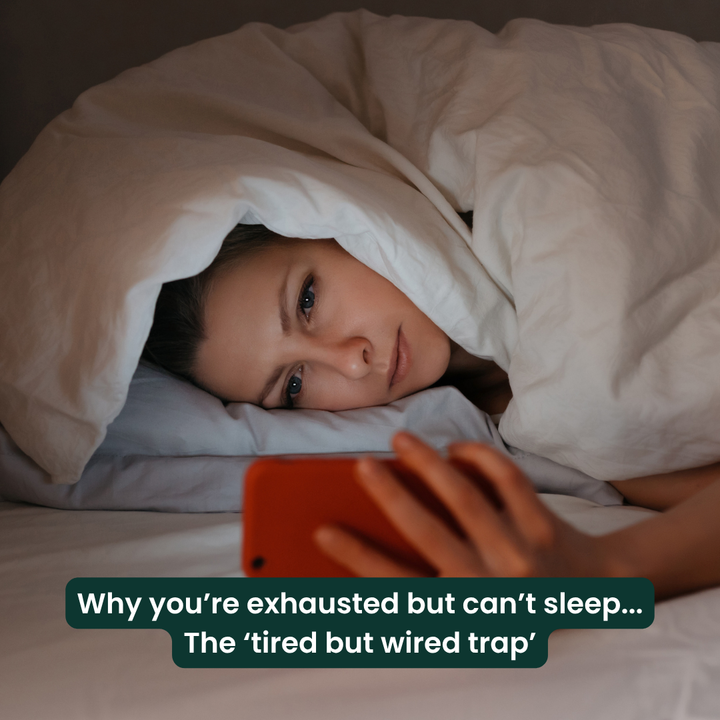
The "Tired but Wired" Trap
A Note From Paul - medical herbalist, naturopath and founder of Core Botanicals®

In my clinical experience, one of the most common complaints I’ve heard over the last three decades is some variation of: "Paul, I’m exhausted all day, but as soon as my head hits the pillow, my mind starts racing."
I call this the "Tired but Wired" trap. It’s a hallmark of our modern, fast-paced, goal-oriented world. Consequently, we’re living in a state of "sympathetic dominance" where our nervous system is stuck in "fight or flight" mode, even when we’re just sitting at our desks or trying to sleep. The thing that’s not well known about the "fight-or-flight" or sympathetic nervous system (SNS) mode is that it’s only half of the autonomic nervous system (ANS); the other half is called the “rest-and-repair” or parasympathetic nervous system (PNS), which balances the sympathetic nervous system and together optimise the automatic functions of the ANS.
A great way to appreciate the differences is to imagine you’re picnicking under the iconic African “tree of life” (Baobab Tree) after a tiring safari on the savanna. You relax as you take in the scenery and recover as you enjoy some nourishing provisions. In this context, your parasympathetic mode is dominant. There you are feeling high on life when suddenly your sympathetic mode kicks in as a pride of lions approach. As they do, your appetite is replaced by fear and anxiety, and your bliss is banished by stress hormones surging through your body to raise your blood pressure and heart rate in readiness to fight for your survival or run for your life. All this happen below conscious control as part of our evolutionary responses governed by the ANS. So, although we’re no longer on the savanna, our modern cities can still feel like the jungle.
From a Traditional Chinese Medicine (TCM) perspective, the ANS is primarily understood through the lens of Yin-Yang balance, where the SNS is associated with Yang (activity, growth, defence, exertion) and the parasympathetic system with Yin (passivity, digestion, rest, repair). Chinese herbs and acupuncture act as dynamic regulators that harmonize these systems and correct imbalances associated with sympathetic dominance such as mild anxiety, irritability, restlessness, excess nervous energy and poor sleep.
In contract to the use of sedative drugs that "knock you out" to reduce anxiety, Western Herbal Medicine seeks to correct sympathetic dominance with Adaptogens.
Adaptogens are a unique class of herbs that help your body adapt to stress. They don't just control symptoms; they work on the primary mechanisms that govern your body’s response to stress including the ANS and the command and control, hormonal system called the Hypothalamic-Pituitary-Adrenal axis (HPA). The HPA and ANS act as complementary, highly coordinated, and physically interconnected systems that calibrate your body’s response to stress.
In summary, the ANS provides a rapid, immediate response (within seconds) through sympathetic ("fight-or-flight") activation and parasympathetic (“rest-and-repair”) withdrawal, while the HPA axis provides a slower, sustained, hormonal response (over minutes and beyond) via cortisol release from the adrenal glands. However, prolonged activation of the “stress response” can lead to a "disconnection" or "disequilibrium" between these two dynamic, interrelated systems leading to many conditions modern humans experience in today’s version of “life in the jungle”.
For this very common "Tired but Wired" state, I rely heavily on two of my favourite Adaptogens: Ashwagandha (Withania) and Sacred Basil (Holy Basil). In our STRESDEFEN formula, we use these highly respected Ayurvedic Rejuvenating tonics herbs which help the body “adapt to stress” through more efficient and effective responses, together with two powerful Chinese herbs China Root and Chinese Senega that "soothe the spirit" (Shen) to calm the mind, aid mental relaxation, ease restlessness and reduce excess nervous energy.
In a nutshell, the goal of this dynamic approach is to calm the "wired" nervous energy while simultaneously rejuvenate the "tired" energy reserves.
What sets our formulas apart is the potency. Most liquid medicines you find on the shelf are tinctures (1:2 or 1:5) not extracts (1:1 or 1.5:1) with their strengths varying widely. Core Botanicals has developed a special dual-phase extraction system to produce a 1.5:1 extract strength that’s three times the potency of a 1:2 tincture. This means you’re getting three times the dry herb equivalence per mL, compared to many leading brands of 1:2 strength liquid medicines.
So, when you’re stuck in a stress cycle, it’s important to take the right herbs at a dose that can actually “move the needle”. I've also found that fresh air, moderate exercise and meditation support herbal medicines that regulate and rejuvenate your nervous system. A simple approach is to get outside and breath in a dose Nature’s most effective tonic combination: fresh air and sunshine. Research demonstrates this can have positive effects on moods and wellbeing by boosting blood oxygen and Vitamin D levels.
Paul’s Clinical Tip: If you find yourself "spiralling" in the mid-afternoon, that’s usually when your cortisol is fluctuating. Try a dose of STRESDEFEN around 3 PM instead of drinking coffee or coke (both caffeine hits) to help reduce that afternoon brain fog and energy slump. Also, try another dose around 9 PM to get you ready for sleep and prevent the "second wind" that keeps you awake.
To your health,
Paul Keogh
Founder, Core Botanicals